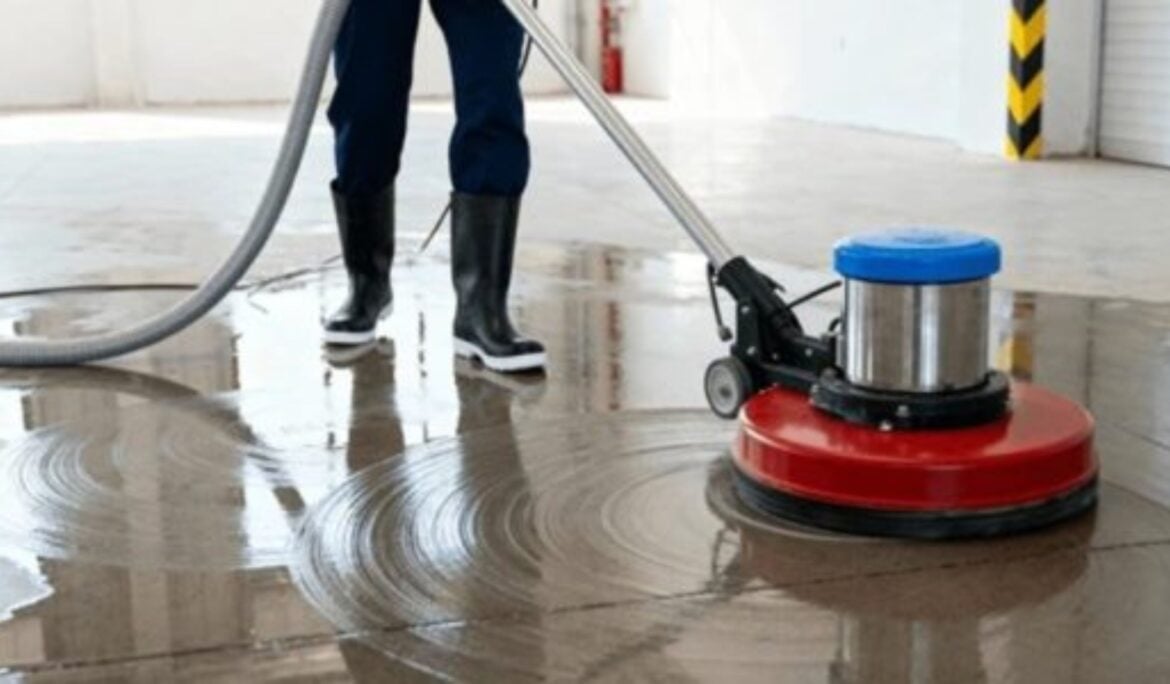
Commercial concrete grinding in Buckeye involves using diamond-tipped grinding machinery to smooth, level, and prepare a concrete floor surface typically prior to the application of a new coat of finish, epoxy, or other surface treatment. The choice is a critically important one for all business owners in Buckeye’s expanding industrial/commercial corridors, and can make the difference between a floor coating that lasts for years and one that breaks down within a few months.
The commercial and industrial floors at Buckeye have a common requirement – they all need to be surface prepared before any coating is applied. Understanding the nature of grinding can be the basis for a more successful, less costly flooring job.
Why Commercial Concrete Grinding Matters
Even though it is a concrete slab that appears flat and solid, it is almost never ready to be coated as soon as it is cast. Surface conditions which prevent adhesion are found on both new pours and older floors, as well as builder-grade slabs used in newer Buckeye developments.
Grinding is important because it:
- Cleans off previous coatings, sealers, paint or adhesive residue.
- Opens the pores in the concrete for coatings to bond to it effectively.
- Smooths out high spots, trowel marks and slight irregularities.
- Removes surface contaminating material such as oil, grease or curing compounds.
- Reworks an even surface on the entire floor.
One of the most common causes of commercial coatings early peeling, bubbling or delamination is that this action is being skipped.
Signs Your Commercial Floor Needs Grinding
Not all floors will have easily visible damage prior to grinding and coating. Some of the signs to look out for are:
- Cracks, pitting or spalling on the surface.
- An old coating that is peeling, flaking or discolored.
- A slab that is rough, dusty or chalky to walk on.
- Oil, chemical and heavy equipment stains.
- Unlevel areas which retain water or pose a tripping hazard.
- Newer slab, with still hard, shiny “as-poured” surface.
If any of these signs occur in your facility, grinding is a good first step before any coating work is started.
The Commercial Concrete Grinding Process
The typical sequence for a professional grinding project is as follows, but the number of passes and grit sizes used will vary depending on the conditions of the floor and the product system to be applied to the floor.
- Site assessment – crew checks for slab cracks, moisture, in-slab coatings.
- Floor prep and containment – Equipment and dust containment barriers are set up to protect the surrounding space.
- Coarse grinding – Low-grit diamond tooling will remove old coatings, high spots and surface contamination.
- Progressive grinding – The floor is reprogressed using a medium and fine grit.
- Crack and joint repair – Any cracks, spalled surfaces and control joints are patched or filled.
- Vacuuming and cleaning – Dust and debris are totally removed with the help of an industrial vacuum system connected to grinders.
- Moisture and profile testing – The slab is tested to ensure it is proper for the next coating step.
The process is much cleaner today with the use of dust shrouded grinders that are fitted to a HEPA vacuum cleaner and maintained during operation, avoiding the contamination of business air quality that occurred with older methods.
Wet Grinding vs. Dry Grinding
Most commercial jobs in Buckeye use dry grinding, but it helps to understand how the two methods compare.
| Factor | Dry Grinding | Wet Grinding |
| Dust control | Managed with vacuum shrouds | Managed with water, but creates slurry |
| Best for | Most commercial/industrial floors | Very dense or hard aggregate slabs |
| Cleanup | Vacuumed dust, minimal mess | Requires slurry collection and disposal |
| Indoor use | Preferred for occupied buildings | Rarely used indoors |
| Speed | Faster overall turnaround | Slower due to water management |
Diamond Grit Levels Explained
Grinding is done in stages using progressively finer diamond segments. Each grit level serves a different purpose in preparing the slab.
| Grit Range | Purpose | Typical Use Case |
| 16–30 (Coarse) | Removes coatings, adhesives, high spots | Heavily damaged or coated floors |
| 40–80 (Medium) | Levels and smooths the surface profile | Standard prep before epoxy or coatings |
| 100–200 (Fine) | Refines surface for a smoother finish | Floors needing a tighter profile |
| 400+ (Polishing) | Creates a polished, glossy look | Polished concrete flooring projects |
Where Commercial Concrete Grinding Is Used
The concrete grinding process is not confined to any kind of building. It is widely used in the following applications in Buckeye:
- Warehouses and distribution centres.
- Manufacturing and industrial buildings
- Retail stores and showrooms
- Commercial and restaurant kitchens
- Service bays and auto shops
- Buildings in office use and lobby areas
- Parking buildings and loading docks
Newer commercial developments around sites such as Verrado and Festival Ranch often require grinding as well, since builder grade slabs are often intended for functional purposes, not to be coated.
Typical Cost and Timeline Factors
Pricing for commercial concrete grinding depends on square footage, floor condition, and the number of grinding passes needed. Below is a general breakdown of what affects the estimate.
| Factor | Lower Cost/Faster Timeline | Higher Cost/Longer Timeline |
| Floor condition | Clean, undamaged slab | Cracked, coated, or contaminated slab |
| Square footage | Smaller spaces | Large warehouses/industrial floors |
| Grit passes needed | Single or double pass | Multiple progressive passes |
| Repairs required | None | Crack filling, spalling repair |
| Building downtime | Off-hours or phased work | Full facility shutdown needed |
Most commercial grinding projects are priced per square foot, with final numbers depending on an on-site evaluation of the slab.
Ready to Prepare Your Commercial Floor?
The base of a long-lasting floor coating system is commercial concrete grinding. This is an important step to take when investing in a new Buckeye floor to ensure that your investment is protected and your floor performs well under daily commercial or industrial use. For those in the midst of a coating project, a grinding assessment by a professional is a good starting point.
What Do Buckeye Business Owners Usually Ask Before They Call
Most commercial jobs are finished in 1 to 2 days or less, depending on the size of the space to be treated.
In many cases, yes. Grinding can sometimes be done in phases or late at night to minimize disruptions.
In a professional environment, vacuum shrouded grinders are used which suck up the majority of the dust throughout the grinding process.
Grinding is nearly required on every floor as it will provide a good bond for nearly all clean looking slabs.
Grinding takes care of the smoothness of the surface, but cracks and spalled areas are normally addressed with a separate repair in the prep process.
Both are used to prepare concrete for coatings, but grinding is done with diamond discs, and shot blasting is done with steel shot; grinding will tend to smooth the surface and create a more consistent profile.
Yes, fine grit grinding is one of the best methods to get rid of old, worn, or peeling paint.
After the floor is cleaned, tested, and determined suitable for coating, the process will usually start the same day or soon thereafter.
Yes, even a freshly poured slab should have a top layer that is hard and sealed off, and needs to be cut to allow a coating to bond properly.
Minor high spots can be leveled by grinding, and transitions can be smoothed, however, most major slope changes will need an additional underlayment leveling or self-leveling step.
Larger facilities tend to have a ride-on or walk-behind planetary grinders that can cover more square footage of floor space per pass than smaller handheld grinders.
Yes, the surface profile varies depending on the coating, and depending on whether it is epoxy, polyurea or another coating system, the grit sequence and number of passes will vary.
The texture of a properly ground floor should be continuous and uniform and there should be no glossed or untouched areas left.
The noise which is produced by grinding equipment is noticeable and for this reason a number of contractors work during off-hours, or in sections, in occupied buildings.
Yes, but most metal that may be embedded in a component is usually detected and ground down or cut off and discarded separately from the main grinding operation to prevent damage to the machine.
Ready to Prepare Your Commercial Floor?
The base of a long-lasting floor coating system is commercial concrete grinding. This is an important step to take when investing in a new Buckeye floor to ensure that your investment is protected and your floor performs well under daily commercial or industrial use. For those in the midst of a coating project, a grinding assessment by a professional is a good starting point.