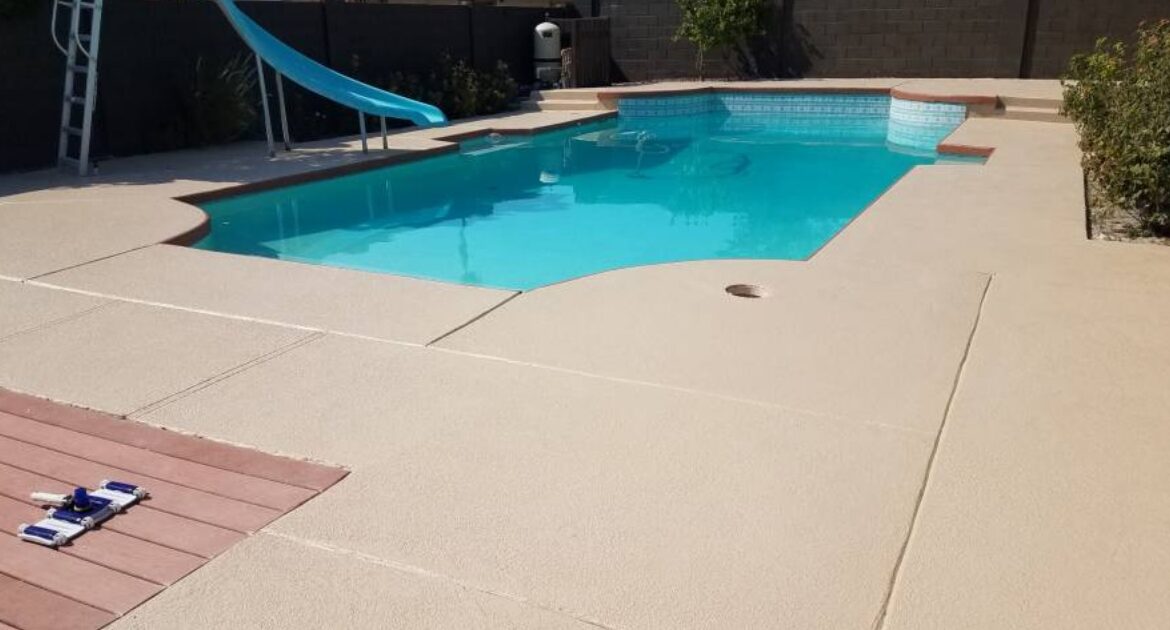
There’s nothing like stepping with bare feet onto a crack in hot, dry concrete. When your pool deck is sun-bleached, spider-webs, has cracks, is too hot for a dog to do the four-paw hop — you’re probably asking the question every Arizona homeowner asks: how much does a pool deck resurfacing cost and is it worth it before I just tear it out?
The great thing about resurfacing is that it’s one of the most affordable methods of reviving a worn backyard — and is usually 30 to 50 percent less expensive than demolition and repouring the entire deck. It’s quicker, it doesn’t harm your landscaping or pool equipment, and in most cases it can be completed within a week from initial evaluation to cure.
This guide goes deep into concrete pool deck resurfacing with real prices for every deck and material in Arizona, a detailed comparison of all the major resurfacing options, a step-by-step guide to the work process, a maintenance roadmap after the crew departs, the mistakes to avoid making, and answers to the 20+ questions homeowners search most. Whether you’re preparing to hire contractors or simply wondering if resurfacing is the right choice, you’ll leave this article with one number in mind.
What Is Pool Deck Resurfacing?
Pool deck resurfacing involves replacing the existing surface or overlaying your pool with a new, textured layer rather than tearing it up and replacing it altogether. A resurfacing crew works with what is already there, as opposed to draining landscaping, fencing and sometimes even pool equipment out of the way, jackhammering out the slab, and pouring new concrete (which can take weeks).
All without the complexity, mess or weeks of a complete teardown, the process fixes cracks, restores faded color and adds slip resistance. In Arizona, that usually translates to a cool deck resurfacing of some kind—a textured acrylic coating designed to keep a deck cooler to walk on than uncoated concrete, which can easily be hot enough to burn on a July afternoon in Phoenix in just a few seconds. That is simply what cool deck systems are for.
It’s important to note that resurfacing is different from a few similar terms that homeowners frequently get confused with:
- Resurfacing — a new coating or overlay is attached to the original slab.
- Refinishing — typically synonymous with resurfacing, which means a refresh of the top-level.
- Replacement — repair with new concrete (full demolition).
- Repair — patching or spalling of random cracks without applying a new coating over the entire surface area.
In cases where there are no structural problems (no major settling, heaving or cracking to the foundation) and the damage is mainly cosmetic or of the surface, resurfacing is typically the best choice.
Why Cool Deck Resurfacing Is So Popular in Arizona
It’s easy to see the benefits of cool deck resurfacing, which is a standard solution among Phoenix area contractors for good reason. This is achieved by incorporating small voids within a hand-textured acrylic surface, reducing the heat mass of the concrete from storing and radiating sun. The payoff:
- The surface temperatures are up to 30-40°F cooler than plain concrete.
- A smooth, non-slip finish for safer use around pool edges where there is water.
- Improved UV resistance, monsoon weather and pool chemical spill resistance.
- An assortment of colors to update the entire landscape of your backyard; more than a dozen to be precise
- The color of the product, such as lighter colors (tans, off-whites, soft grays) reflect more heat than darker colors, so color choice alone impacts comfort.
The climate of the State of Arizona is very severe on concrete. Near constant exposure to the sun’s ultraviolet rays, the tremendous temperature variations from day to night, monsoon rains that can pour an inch of rain down onto a deck in an hour, and hard water that leaves a residue of calcium deposits all take their toll and combine to make a bare or poorly-sealed deck wear out before almost any other place in the country. That is what makes cool deck coatings a regional norm and not just one option among many.
Average Pool Deck Resurfacing Cost in Arizona
The average homeowner in the Phoenix Valley and in the state of Arizona pays:
- Between $3 and $9 per square foot, depending on material and condition.
- $2,000 to $4,500 total for a standard 500 sq ft deck.
- Additional cost of $1.30 to $2.00 per square foot if the coat is old and deteriorating and must be stripped first.
- If you are doing a texture finish on new concrete, rather than a resurface, expect to pay $5 to $10 per square foot.
Cost by Deck Size
The total price increases in direct proportion to the square footage, but larger projects may have a slightly lower per-square-foot price, as the mobilization, set up and equipment costs are proportionately reduced over more space.
| Deck Size | Estimated Cost Range (Cool Deck) | Estimated Cost Range (Stamped/Premium) |
| 200 sq ft | $700 – $1,800 | $1,400 – $3,000 |
| 500 sq ft | $1,500 – $3,500 | $3,000 – $6,000 |
| 800 sq ft | $2,400 – $5,600 | $4,800 – $9,600 |
| 1,200 sq ft | $3,600 – $8,400 | $7,200 – $14,400 |
| 2,000+ sq ft | $6,000 – $14,000+ | $12,000 – $24,000+ |
These figures assume a slab that’s in reasonably good structural condition. Decks that need significant crack repair, releveling, or old-coating removal will land at the higher end of these ranges — or above them.
What Affects Your Pool Deck Resurfacing Cost?
- Deck size — the larger the deck the more material and labor required.
- Material choice — basic cool deck coating is quite a bit less expensive than stamped concrete, pavers, or tile.
- Current condition — Cracks and hard water calcium buildup add prep work.
- Design complexity — The more complex the design, the more colors, patterns, textures, or stamps will be involved, and the higher the cost.
- Removal needs — Stripping an old, deteriorating coating requires additional labor.
- Contractor experience —licensed and insured professionals tend to bill at higher rates, but they will keep you from costly do-overs.
- Access and layout — decks that have limited side-yard access, lots of curves, steps, built-in features (fire pits, planters, water features) require more time to coat evenly.
- Season and demand — contractors are usually in high demand both in terms of price and wait times during the spring and early summer months which are peak seasons for them.
- Number of coats and topcoat quality — An expensive UV-stable topcoat might be more expensive than a quality basic coat but can be used more times for the entire system.
Pool Deck Resurfacing Cost by Type
| Resurfacing Type | Cost Per Sq Ft | Avg. Cost (500 sq ft) | Typical Lifespan |
| Cool deck / acrylic coating | $3 – $7 | $1,500 – $3,500 | 10–12 years |
| Basic overlay or paint | $3 – $5 | $1,500 – $2,500 | 8–10 years |
| Knockdown / spray texture | $4 – $6 | $2,000 – $3,000 | 10–12 years |
| Stamped concrete overlay | $6 – $12+ | $3,000 – $6,000+ | 12–15 years |
| Epoxy / polyaspartic coating | $5 – $10 | $2,500 – $5,000 | 15–20+ years |
| Travertine or flagstone pavers | $10 – $18 | $5,000 – $9,000 | 20–25+ years |
| Rubber decking | $8 – $14 | $4,000 – $7,000 | 15–20 years |
| Porcelain or ceramic tile | $12 – $20+ | $6,000 – $10,000+ | 20–25+ years |
Higher upfront cost generally buys you a longer lifespan and less frequent maintenance, so it’s worth thinking about cost-per-year of service rather than just the sticker price. A $2,000 cool deck coating that needs a recoat every 10 years can end up costing more over 25 years than a $7,000 paver installation that lasts the whole period untouched.
Cool Deck vs. Stamped Concrete vs. Pavers vs. Tile
| Feature | Cool Deck Coating | Stamped Concrete | Pavers | Tile |
| Heat reduction | Excellent | Moderate | Good | Poor to moderate |
| Slip resistance | High, textured | Lower if sealed glossy | High | Varies, check rating |
| Install time | About 1 day | 2+ days | 3–5 days | 3–7 days |
| Repair difficulty | Easy, patchable | Moderate | Easy, swap tiles | Difficult, can crack |
| Best for | Comfort on a budget | Decorative upgrade | Premium, natural look | High-end custom look |
| Maintenance | Low | Low to moderate | Moderate | Moderate to high |
Tile can look stunning around a pool, but it’s worth flagging: glazed tile gets slippery when wet and can retain more heat than a textured acrylic finish, so it’s usually reserved for coping and accent bands rather than the full walking surface in Arizona.
How Pool Deck Resurfacing Works, Step by Step
- Inspect and clean (typically half a day) — the deck is pressure washed and inspected for cracks, delamination, calcium buildup and for moisture behind the surface.
- Repair damage (half a day to two days, depending on severity) — cracks are filled with flexible caulking or patch compound, low spots are levelled and old failing coating is stripped or ground down.
- Prime the surface — use a bonding agent to ensure the new material will bond well and that it will not delaminate.
- Apply the new finish (usually one full day) — Cool deck texture, stamped pattern, or paver style overlay are applied by hand or machine, and may be applied two times for even color and texture.
- Seal and cure (3 to 7 days) — a protective topcoat is applied as the final coat and the deck cures before it will be walked on or refilled/used as normal. In systems using heavy use, up to 2 weeks of full chemical cure may be required.
The weather is a fact of life here. One of the reasons spring and fall are the best times to install in Arizona is the high humidity during the monsoon season or if the nights were unexpectedly cold, can help to extend cure times.
Signs Your Pool Deck Needs Resurfacing
- Cracks, chips or flaking that are visible.
- Concrete that is faded, blotchy, or discolored.
- Unsmooth or slippery areas that are not safe to walk on.
- After rain, the water is standing or there is poor drainage.
- Calcium deposit that does not rub off (efflorescence).
- Areas that are hollow or spongy to the touch, which might be an indication of delamination.
- The deck becomes too hot to go around walking on it without shoes.
Benefits of Resurfacing Your Pool Deck
- Removes the need for a full deck replacement, which is much less expensive than that.
- Enhances home value and resale potential.
- Makes it easier to feel comfortable on a cooler, textured surface.
- Saves the seal from spreading more cracks.
- Available in a wide range of colors and finishes.
- Minimal disruption; most homes still can use the pool area within 1 week.
- Saves years of costly repairs and replacements to existing concrete slabs.
DIY vs. Professional Pool Deck Resurfacing
DIY paint strippers start at $100 to $300 for small areas ($1.50 per sq ft), and can be effective for minor areas such as a small crack in a corner or a strip in the walkway that is fading.
When your inground pool deck is completely filled, that’s another issue. It involves moisture testing, crack treatment, exact mixing ratios, and controlled curing conditions — if you catch moisture, don’t cover it with a good coat of primer, or rush the cure, you’ll be doing it all over again on your own dime. Typical mistakes by the do it yourselfers are:
- Applying coating on the drying slab, which is not fully dried after pressure washing.
- If the new coating cracks in the same areas within a year, the coating has failed to bond with the crack and should be rehabilitated with crack repair.
- Differences in texture caused by irregular trowel or brush application.
- Applying a non-UV-stable topcoat which causes yellowing or peeling in just a season.
However, most homeowners pay for the installed cost of the professional resurfacing, which ranges from $3,000 to $10,000, and end up with a longer-lasting, warrantied finish for a relatively low extra cost over installing materials only. The labor and skill required for this type of work, this much into the public eye, is typically worth the price.
How to Choose a Pool Deck Resurfacing Contractor in Arizona
- Check that they have licences and insurance for concrete work in your jurisdiction.
- Be specific when asking about cool deck resurfacing experience, rather than just concrete.
- Insist on a written guarantee and find out specifically what it includes (materials, labour or both – and for how many years).
- Get at least 2-3 estimates – costs may vary as much as 20-40% from one contractor to another
- Before locking in a final price, ask about how they prep, crack repair and curing.
- See examples of their previous work, preferably some that are a bit older and can be assessed as to how well the finish has lasted.
- Discuss with them what will happen in the event of rain or the monsoons.
- Make sure everyone understands the specific items that need to be moved, equipment to be covered and/or landscaping to be protected during the job.
Tips to Save Money on Pool Deck Resurfacing
- Opt for simple cool decking coatings instead of stamped or patterned finishes.
- Plan during spring and fall times rather than during peak summer times when there is increased competition for contractors and prices may be higher.
- Mobilize for other work in the backyard, such as pool re-plastering or fence repairs, in addition to the bundle, to reduce mobilization expenses.
- Prep work for structural repairs needs to be done more carefully and can be much larger if small cracks are not addressed early on.
- Check several estimates and find out exactly what’s covered in each — some estimates do not include the repair of cracks or removal of old-coatings, so a “cheap” estimate can quickly become the most expensive.
- Inquire about a discount on off-season or multiple project jobs.Request for an off-season or multiple project discount.
Maintaining Your Resurfaced Pool Deck
Just a bit of maintenance can yield the maximum 10 to 12+ years of performance from a cool deck coating:
- Regularly rinse off pool chemicals, sun-tan lotion and dirt using a hose.
- Don’t pull heavy furniture across the top as that can scuff the texture.
- Even if the surface does not show signs of wear or tear, re-seal every 2 to 3 years to keep the color and UV protection.
- Tackle minor repairs such as cracks or chipped paint as soon as they occur, before they become a bigger problem.
- Choose cleaners that are pH neutral; acidic cleaners will break down over time.
- Pay attention to waterlogging after monsoon rainfall – if standing water is left to sit several times it will reduce the coating’s lifespan.
Common Mistakes to Avoid
- Selecting the lowest price without asking the question of whether it will include crack repair and a removal of old-coating.
- Forgetting to mention the warranty at all.
- Instead of solving the problem first, resurfacing over a slab that has structural issues that remain to be solved (settling, heaving).
- Choosing a particularly dark shade for heat reduction, darker shades tend to absorb more heat, and can help counter the cooling effect of the texture.
- Playing in the pool area before the manufacturer’s recommended cure time is up.
Closing Insights
Most Arizona homeowners will find that the cost of pool deck resurfacing is in the range of $2,000 and $6,000; a fairly small sum for a cooler, safer, and more beautiful backyard for another 10 years or more. While a complete tear out may seem like the obvious choice when you are in the process of remodeling, resurfacing is often the wiser option than replacing the entire deck – before you even consider a full tear out. Want to have one for your own yard? An Arizona pool deck installation company, such as NLKD Concrete Coatings, can provide you with an accurate price quote after a quick on-site inspection of your pool deck.
Frequently Asked Questions About Pool Deck Resurfacing in Arizona
Most projects run $3 to $9 per square foot, or about $2,000 to $4,500 for a typical 500 sq ft deck. Bigger or more elaborate projects may have a higher rate.
“Kool Deck” is a particular trademarked product from one company – “cool deck” is the common vernacular for any type of textured acrylic finish designed to remain cooler to walk on, regardless of manufacturer.
As much as 30-40° cooler, according to data from contractors in the Phoenix area — a significant difference when it’s 115°F outside and bare concrete can reach temperatures of over 150°F in direct sunlight.
A good maintenance will usually last for 10 to 12 years, a resale of the compound should be performed every 2 to 3 years and the small cracks should be addressed promptly.
Small patches are do-it-yourself projects, while a complete inground deck is advisable to be left to the professionals to avoid moisture, adhesion and curing issues that are easy to mess up on the first time.
For small areas, the materials cost is approximately $100 to $300, but $1.50 per square foot for coating products (excluding any tools you might need to purchase or rent).
Cool deck acrylic coatings and polyaspartic systems both offer a greater reflection of heat and UV resistance than plain or glossy sealed concrete and are both excellent choices for comfort under foot.
It can help — a fresh, crack-free deck appears like a well-maintained back yard and helps in improving curb appeal, something buyers look at when evaluating outdoor living space.
Most jobs can be made in 1-2 days, and then will cure to full use in 3-7 days, depending on system and weather, but can be chemically cured in up to 14 days.
It’s typically caused by intense heat, UV exposure, large day/night temperature fluctuations, monsoon rains, and hard-water calcium deposits, which may take years to cause.
It looks really nice but will retain more heat and may be smoother than textured cool deck if finished with a glossy surface, so it may be a compromise between look and feel.
The cost of stripping a failed coating prior to resurfacing is $1.30 to $2.00 per square foot, depending on the number of layers of the coating that must be removed.
This will depend on the city and the extent of the work — sometimes it is not necessary, but check with the local building department, particularly for structural repairs.
It is best done in spring or fall, as this will exclude the excessive heat and humidity of summer, and the contractors are generally less in demand.
Not dramatically — the statewide range of roughly $3 to $9 per square foot applies across most Arizona metro areas, though labor rates can shift slightly by region.
Yes — Cracks are cleaned, filled and sealed before the new textured coating is applied over the repaired area, although extremely active structural cracks may require repair prior to texturing.
Arizona contractors will have a dozen and more colors, and many custom blends. Lighter shades will reflect more heat in a hot climate.
You can budget to be $5 to $10 per square foot, and the product will last 15 to 20 years or more, and will have more UV stability than a standard acrylic coating.
Yes — Resurfacing will usually be 30-50% less expensive than demolishing and repouring a full deck and will require very little time.
In the harsh Arizona environment, a light maintenance recoat is recommended every 2-3 years to keep the color and slip resistance.
In some cases — minor regrading can be incorporated with the resurfacing process, but major drainage problems may require grading or drainage before the resurfacing can be accomplished.
Yes — many contractors can include decorative borders, banding or minor shape changes with the resurfacing, at a little extra cost.
Warranties range from 1 to 5 years for materials and workmanship; check for warranties in writing before you sign.
Usually not for wear and tear or cracking due to age, unless the damage is from an event covered under the policy, such as storm damage – please refer to your policy directly.
Yes, especially for larger decks, but contractors usually suggest that it should be done in one application, so that the color and texture are even throughout.